Thai Immigration has tightened checks on Thai-national children under 18 who leave the country. On 4 November 2026 the Immigration Bureau set out the documents parents and other adults should carry at departure. These are a valid passport and the child's birth certificate in every case. In many cases there is also an officially made consent letter that is no more than 60 days old. If you are a foreign parent of a Thai child, or a mixed Thai–foreign family planning a trip home for the holidays, this affects you at the departure counter.
Last reviewed: 9 November 2026. Checked against the Suvarnabhumi Airport Immigration notice and Thai press reports of the 4 November Immigration Bureau briefing.
At a glance
- Who: children of Thai nationality under 18 leaving Thailand. A child who also holds a foreign passport is still a Thai national for these checks.
- Always carry: the child's valid passport and birth certificate. The birth certificate can be the original, a photocopy or an electronic photo on a phone.
- Travelling with only one parent: a consent letter from the other parent, issued by a government agency. Add documents showing parental authority if the parents never registered their marriage or are divorced.
- Travelling with a court-appointed legal representative: a copy of the court order appointing them.
- Travelling with anyone else (grandparents, relatives, friends, tour leaders): a consent letter from both parents or the legal representative, issued by a government agency.
- Consent letters must be made in front of an official at a district office (khet or amphoe) or at an embassy, and must be no more than 60 days old.
- School trips: groups travelling with a school under the Ministry of Education or the international schools association can use a school certification letter instead, if the school has completed the Ministry's consent and approval steps.
Why Immigration is doing this
Immigration Bureau commissioner Pol Lt Gen Nopasilp Poonsawat announced the stricter screening on 4 November together with the director-general of the Department of Provincial Administration. The stated aims are to prevent human trafficking, cross-border child abduction and children being taken out of Thailand unlawfully. Officers check the relationship between the child and the adult travelling with them, as well as the papers.
The bureau said that between July and October 2026 officers screened 120 Thai-national children in this way. In 32 cases the documents and statements of Chinese mothers and Thai fathers raised suspicion. Those children were refused departure and the cases led to investigations and arrests. Thai media have called these cases "fake Thai father" schemes.
The rule is not brand new. On 3 August 2026, Suvarnabhumi's departure immigration section told families that Thai children under 18 would need a birth certificate and, where required, a government-issued consent letter. Before that, a passport alone was usually enough. The 4 November briefing turned this into a bureau-wide message and spelled out the consent cases.
The four travel situations
1. Both parents travelling with the child
The announced list does not name an extra consent document when both parents travel together. Carry the child's passport and birth certificate. Make sure the parents' names on the birth certificate match their passports. If your names have changed since the birth, for example after marriage, bring proof of the change. That kind of mismatch is exactly what officers are told to look for.
2. One parent travelling alone with the child
This is the case most likely to catch foreign parents out. The parent who is not travelling must give consent in person before an official, at a district office in Thailand or at a Thai embassy abroad. A letter you sign yourself or have witnessed privately is not the procedure Immigration described. If the parents never registered the marriage or are divorced, also bring papers showing who has parental authority. The announcement does not list which papers are accepted, so ask your district office what proves custody in your case.
3. A legal representative (guardian) travelling with the child
Bring a copy of the court order appointing the legal representative, along with the passport and birth certificate.
4. Anyone else travelling with the child
Grandparents, aunts and uncles, nannies and family friends need a government-issued consent letter from both parents, or from the legal representative. The same 60-day limit applies.
Practical tips for mixed Thai–foreign families
- Count the 60 days backwards from your departure date, not from booking. A letter made in September for a late-December trip will be too old. Book the district office or embassy appointment for a date close to travel.
- Plan for the parent who stays behind. If that parent is abroad, they can make the consent at a Thai embassy or consulate. Ask the mission what it needs first.
- Carry originals as well as phone photos. Photos are accepted for the birth certificate. The announcement does not say whether a photo of a consent letter or court order is enough, so bring the paper.
- Dual nationals are covered. The rule applies to children of Thai nationality, so a child with a Thai parent who also holds a foreign passport should be treated as covered. Bring both passports and make sure the ticket name matches the passport you show.
- Allow extra time at departure. Officers can refuse departure while they look into discrepancies, and that can cost you your flight. Arrive early in the peak December period.
- School groups: if your child is going on an exchange or sports trip, confirm with the school that it has issued the certification letter.
Checklist before you fly
- Child's Thai (or other) passport, valid for the trip.
- Child's birth certificate: original, copy, or a clear phone photo.
- If one parent is not travelling: consent letter made before an official at a district office or embassy, no more than 60 days old on the day you leave.
- If parents are unmarried or divorced: proof of parental authority.
- If travelling with a guardian: copy of the court order.
- If travelling with someone else: consent from both parents or the legal representative, made officially.
- Names on all documents match, with proof of any name change.
- Extra time at the airport.
Sources
- Suvarnabhumi Airport Immigration, notice on what to do when Thai children under 18 leave the kingdom: https://bkk-airport.immigration.go.th/?p=5032
- MGR Online, 4 November 2026, Immigration Bureau briefing on screening minors and the "fake Thai father" cases: https://mgronline.com/crime/detail/9690000105755
- Khaosod, 4 November 2026: https://www.khaosod.co.th/around-thailand/news_10460445
- The Nation, 4 August 2026, Suvarnabhumi birth-certificate notice: https://www.nationthailand.com/news/general/40069361
- ASEAN NOW, November 2026, tightened exit checks for children under 18: https://aseannow.com/thailand-news/thailand-tightens-exit-checks-for-children-under-18-r4733/
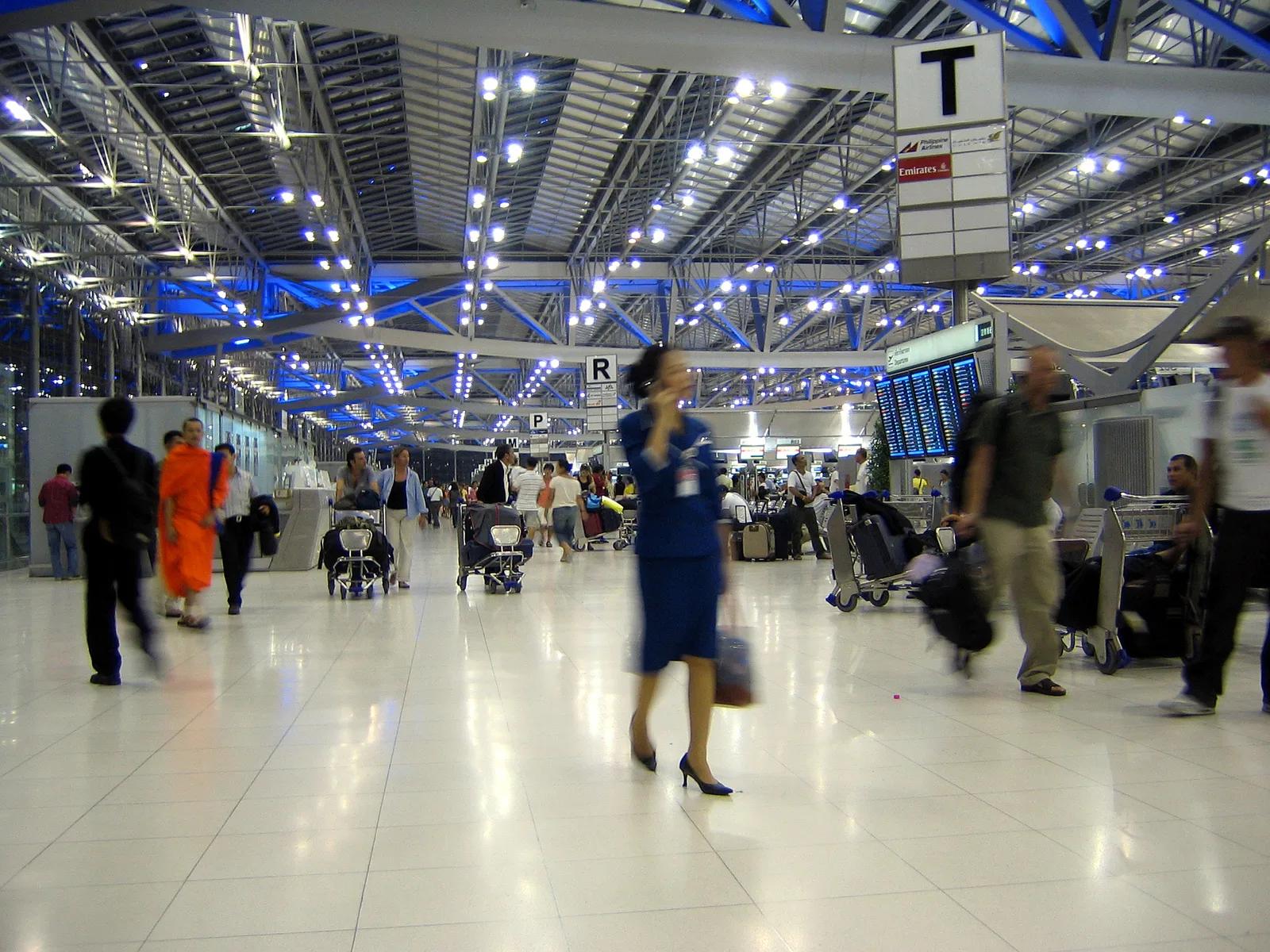
Image: "Suvarnabhumi Airport Departures Hall Bangkok Thailand" by Khaosaming, via Wikimedia Commons, licensed CC BY-SA 3.0 (https://creativecommons.org/licenses/by-sa/3.0).
This article is general information for families travelling with Thai children. It is not legal advice, and Foreigner's Thailand is not a visa agency. Requirements and officer practice can change, and individual cases (custody disputes, adoption, surrogacy) may need more. Confirm with Thai Immigration, your district office, or the Thai embassy or consulate before you travel.