Last reviewed 26 November 2026
With five weeks left in 2026, many foreigners living in Thailand are asking the same question: if I move money from abroad into my Thai account before 31 December, will it be taxed? The answer depends on two things the Revenue Department spells out in its own guidance: whether you were a Thai tax resident in the year the income was earned, and whether that income is brought into Thailand. A widely reported plan to exempt income remitted in the year it is earned, or the year after, is still only a draft, so the rule that has applied since 1 January 2024 is the one that counts for any transfer you make now.
This guide explains the current rule in plain terms, using the Revenue Department's published questions and answers, and ends with a year-end checklist. It is general information, not tax advice.
At a glance
- Tax resident = in Thailand for 180 days or more in total in a calendar year (1 January–31 December), counted across all your stays, whatever your nationality or visa.
- Foreign income earned from 1 January 2024 is assessable if you were resident in the year it arose and you bring it into Thailand, in that year or any later year.
- It is taxed in the year you bring it in, at the normal progressive personal income tax rates.
- Income earned before 2024 is not taxed when brought in (Revenue Department instruction Por. 162/2566).
- The same-year/next-year exemption reported since 2025 is not law as of this review.
- Tax paid abroad may be credited against Thai tax if Thailand has a double taxation agreement with that country.
The two conditions
The Revenue Department's Q&A on section 41, paragraph two, of the Revenue Code explains that its instructions Por. 161/2566 and Por. 162/2566 create a tax obligation on foreign-source income when both of these are true:
- You had assessable income from a foreign source on or after 1 January 2024, in a tax year in which you were in Thailand for 180 days or more; and
- You brought that income into Thailand, in that tax year or in any later year.
If both apply, the income is added to your other income and taxed in the tax year in which it was brought in. The department's own example: someone in Thailand for 200 days in 2024 earns rent from a property abroad that year, then transfers it to a Thai bank account in 2025. That rent is assessable for tax year 2025.
If either condition is missing, there is no charge under this rule. Someone who spent only 65 days in Thailand in 2024 and transferred that year's foreign rent in the same year does not owe Thai tax on it, because they were not resident when the income arose.
How the 180 days are counted
The 180 days are counted per calendar year, adding up all stays between 1 January and 31 December. The Revenue Department gives these examples:
- In Thailand every day of 2024 (366 days): resident for 2024.
- In Thailand for a total of 184 days across several trips in 2024: resident.
- In Thailand for a total of 179 days in 2024: not resident.
- One continuous stay of 250 days, with 100 days falling in 2024 and 150 in 2025: not resident in either year, because neither year reaches 180.
Your visa type does not decide this. A retiree on an extension, a DTV holder and a visa-exempt visitor are all counted the same way.
What counts as "bringing income in"
The Q&A says any method counts: a bank transfer, an online transfer, or carrying the money into Thailand yourself. It also clarifies several points that matter for planning:
- Capital is not income. If you send your own money abroad to invest and later bring the same amount back, that is not assessable income.
- Interest and gains are income. If you deposit money abroad and bring back the principal plus interest, only the interest is assessable.
- Unrealised gains are not taxed. A rise in the value of shares you have not sold is not income; a gain becomes income when you sell, calculated per transaction as the sale price above your cost.
- You decide, and must be able to show, what you are remitting. When an account mixes capital and profit, the Revenue Department says the taxpayer self-assesses which part is which, based on the facts.
- Exchange rate: income is converted at the rate on the day it is brought into Thailand.
- Savings built up while you were not resident (for example, years of working abroad before moving here) are not taxed when brought in.
- Exempt income stays exempt. The department cites inheritance, and support received from parents, children or a spouse up to 20 million baht in a tax year, as examples.
The exemption that is still a draft
In 2025 the Revenue Department proposed exempting foreign income brought into Thailand in the same calendar year it is earned or in the following year. It has been widely reported, which is why many people believe it is already in force. It is not. Such an exemption would need to be enacted, typically as a Royal Decree published in the Royal Gazette, and as of this review legal trackers report that nothing of the kind has been gazetted. The Thaiger also noted on 25 November that the relief remains a proposal.
If you transfer money in December on the assumption that the exemption applies and it is never enacted, or enacted in a different form, that transfer is assessed under the rule in force today.
Double taxation relief
If you have already paid tax abroad on the same income, the Revenue Department says Thai residents can credit that foreign tax against the Thai tax due in the year the income is brought in, under the double taxation agreement (DTA) between Thailand and the source country. Its November 2025 manual for the foreign tax credit tool notes that Thailand has DTAs with 61 countries, that the credit cannot exceed the Thai tax on that portion of income, and that no foreign tax credit is available where there is no DTA. The calculation tool is part of the department's e-Filing system.
Visa programmes with their own tax rules
The Board of Investment's Long-Term Resident (LTR) visa lists a tax exemption for overseas income as one of its benefits. Under the decree behind it, that exemption covers three LTR categories: wealthy global citizens, wealthy pensioners and work-from-Thailand professionals. If you hold an LTR visa, check with the BOI which benefits apply to your category. The Destination Thailand Visa (DTV) carries no tax exemption of its own.
Rates and filing
Foreign income that is caught is added to your other assessable income for the year of remittance and taxed at the standard progressive rates: after expenses and allowances, the first 150,000 baht of net income is taxed at 0%, with rates rising in bands to a top rate of 35%. Nothing is deducted at the moment of transfer. The income goes on your annual personal income tax return for that year, normally due by the end of March of the following year, with the Revenue Department usually allowing extra days for online filing. Check the 2027 filing deadline when it is announced. To file you will need a Thai tax identification number.
Year-end checklist
- Count your days in Thailand for 2026 using your passport stamps and travel dates. Are you at or above 180?
- For each transfer you plan, note when the money was earned and whether you were resident in that year.
- Keep pre-2024 savings separate and hold on to statements showing balances on 31 December 2023.
- Separate capital from income (interest, dividends, rent, realised gains) in your records.
- Record the date and exchange rate of every transfer into Thailand.
- Check whether your income country has a DTA with Thailand and keep proof of foreign tax paid.
- Do not rely on the draft same-year/next-year exemption.
- For large or complex sums, speak to a qualified Thai tax adviser before you move money.
Sources
- Revenue Department, Legal Affairs Division, Q&A on personal income tax under section 41, paragraph two, of the Revenue Code (Por. 161/2566 and Por. 162/2566) (Thai): https://www.rd.go.th/fileadmin/user_upload/porphor/PIT_Sec41_Paragraph2_QnA.pdf
- Revenue Department, Manual for Foreign Tax Credit Calculation Tool (Personal Income Tax), November 2025: https://www.rd.go.th/fileadmin/user_upload/porphor/GuideTaxFromAbroad_EN.pdf
- Revenue Department, Personal Income Tax (residence and assessable income): https://www.rd.go.th/english/6045.html
- Board of Investment, Long-Term Resident Visa programme: https://ltr.boi.go.th/
- The Thaiger, "Thailand can tax the foreign income you bring in, and the year you earned it matters most", 25 November 2026: https://thethaiger.com/hot-news/expats/thailand-foreign-income-tax-expats-what-to-check
- ThaiLawOnline, remittance tax exemption status tracker (last checked 19 October 2026): https://www.thailawonline.com/thailand-remittance-tax-exemption-status/
Editorial note: Foreigner's Thailand is an independent guide, not a tax adviser. This article summarises published Revenue Department guidance as of the review date and is not tax or legal advice. Rules and filing dates can change; confirm your own position with the Revenue Department or a qualified adviser. For questions about your visa or permitted stay, confirm with Thai Immigration or your embassy.
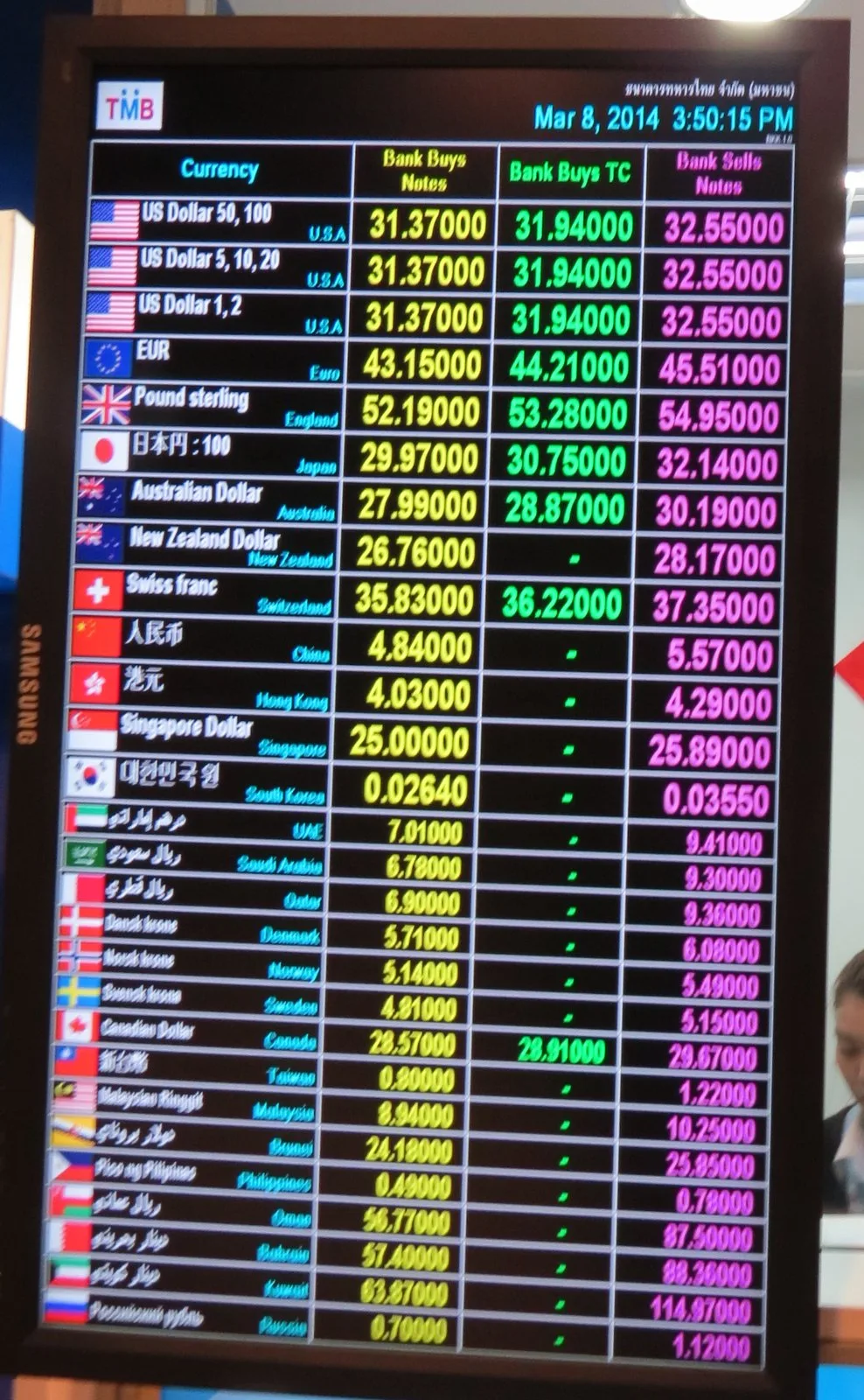
Image: "Currency Exchange in Bangkok Airport, Thailand" by Kathy, via Flickr, licensed CC BY 2.0 (https://www.flickr.com/photos/44603071@N00/18019449543/). Photo from March 2014; the rates shown are not current.