Since 16 October 2026, security staff at airports in Thailand have been allowed to open a checked bag without the owner present if X-ray screening flags something suspicious. In the first ten days, several viral social media posts claimed that bags had been "rummaged through" under the new rule. On 25 October 2026 the Civil Aviation Authority of Thailand (CAAT) published the results of its first review: most of those cases had nothing to do with the new procedure. Here is what the rule actually allows, what CAAT found, and how to pack so your bag is not opened at all.
Last reviewed: 27 October 2026. Checked against CAAT, TAT, PRD and published reports.
The short version
- The rule applies to checked (hold) baggage on flights departing from airports in Thailand, from 16 October 2026.
- Bags are not opened routinely. They are opened only when X-ray screening gives reasonable grounds to suspect a prohibited item or something that could affect flight safety.
- Inspections happen in a designated area, are video recorded, and a Notice of Baggage Inspection is left inside the bag.
- The items found most often so far are power banks and battery-powered electronic devices.
- Use a TSA-compatible lock. If officers have to open a bag with another kind of lock, they may need to cut it or the zip.
What the rule says
CAAT first explained the measure in August 2026. Its notice on searching checked baggage carried in the aircraft hold was issued in February 2026, but the checked-baggage part only took effect on 16 October 2026. The delay gave airports, airlines and other agencies time to prepare staff, systems and passenger communication.
Under the notice, authorised airport security staff may open a checked bag without the passenger if screening identifies an item that is suspicious, prohibited or potentially harmful to aviation safety. CAAT says the same approach is already used in many countries, including Singapore, Japan, South Korea and the United States, as well as parts of the Middle East and Europe. The aim is to resolve a screening alarm without having to find the passenger and bring them back to unlock a bag, which can delay flights.
According to the Government Public Relations Department (PRD), the inspection is video recorded and a Notice of Baggage Inspection is placed inside the bag so the passenger knows it was opened. CAAT adds that records are kept so it can later be checked who opened the bag and what was found.
What CAAT found on 25 October
In its 25 October statement, CAAT said the first days of the rule had gone smoothly overall. It looked into four cases that had circulated online:
- Two cases involved international flights leaving Thailand. Airport CCTV confirmed that neither bag was opened by airport screening officers under the new rule.
- One case involved a flight arriving in Thailand from abroad. Screening before that flight was governed by the airport in the country of departure, so Thailand's rule did not apply.
- One case was a domestic flight where the bag really was opened under the new procedure. Screening had detected a battery-powered electrical device. The passenger had not used a TSA lock, so officers had to cut the zip. An inspection notice was placed inside the bag as required.
Separately, on 21 October Suvarnabhumi Airport said it had reviewed screening records, operational logs and CCTV after a complaint about a bag on a flight to Chongqing. It found that screening had not flagged anything and that the bag went straight to the baggage make-up area under normal procedures. CAAT reached the same preliminary conclusion.
CAAT also warned that opening a bag outside the designated area, outside the set procedure or by someone who is not authorised is not part of the new measure and may be illegal.
How to tell whether your bag was opened under the rule
- Look for the Notice of Baggage Inspection inside the bag. If there is no notice, the opening was not a documented inspection under this procedure.
- Checked baggage remains the airline's responsibility for the whole journey. If something is damaged, missing or looks wrong, report it to your airline first. The airline can investigate with the airport and ground handlers.
- If you have a problem caused by the inspection itself, you can also file a complaint with CAAT at complaint.caat.or.th.
- Remember that bags can also be screened and opened at your transit and destination airports under their own rules.
How to pack so your bag is not opened
CAAT's advice is simple: the fewer reasons screeners have to look, the less likely your bag is to be opened.
- Power banks never go in checked baggage. Carry them in your cabin bag. They were the item found most often in the first ten days.
- Check rules for other battery-powered devices with your airline before packing. Limits vary by device type and by airline.
- Use a TSA-compatible lock, which screeners can open with a special tool and lock again without damage.
- Keep valuables in your cabin bag: cash, jewellery, important documents and anything you cannot do without.
- Photograph the contents before you close the bag and photograph the outside of the bag at check-in. These photos help if anything is damaged, lost or delayed.
Checklist before you fly out of Thailand
- Power banks in your cabin bag, not your checked bag
- Airline's prohibited and restricted items list checked
- TSA-compatible lock on your checked bag
- Cash, jewellery, passport copies and essential medicines in your cabin bag
- Photos of the bag contents and of the bag at check-in
- Rules at your transit and destination airports checked
If you are flying into Thailand
The rule covers bags screened at Thai airports before departure, so on an inbound flight your bag is screened under the rules of the airport you left from. If a bag arrives damaged or late, report it to your airline at the airport straight away. Having a Thailand eSIM set up before landing can make it easier to stay reachable while the airline traces a delayed bag.
Sources
- Civil Aviation Authority of Thailand, CAAT NEWS 33/2569 (25 October 2026, Thai): https://www.caat.or.th/caat-media/220317/
- Civil Aviation Authority of Thailand, CAAT NEWS 32/2569 (21 October 2026, Thai): https://www.caat.or.th/caat-media/220197/
- Civil Aviation Authority of Thailand, CAAT NEWS 28/2569 (6 August 2026, Thai): https://www.caat.or.th/caat-media/214370/
- Tourism Authority of Thailand, enhanced baggage screening procedures (11 August 2026): https://www.tatnews.org/2026/08/thailand-introduces-enhanced-baggage-screening-procedures-information-for-air-travellers/
- Government Public Relations Department, checked baggage may be opened from 16 October 2026: https://thailand.prd.go.th/en/content/category/detail/id/48/iid/551369
- Khaosod English, Suvarnabhumi denies staff searched passenger's bag (21 October 2026): https://www.khaosodenglish.com/featured/2026/10/21/suvarnabhumi-denies-staff-searched-passengers-bag-after-complaint/
- Bangkok Post, new airport baggage inspection starts on Friday (16 October 2026): https://www.bangkokpost.com/thailand/general/3338190/new-airport-baggage-inspection-starts-on-friday
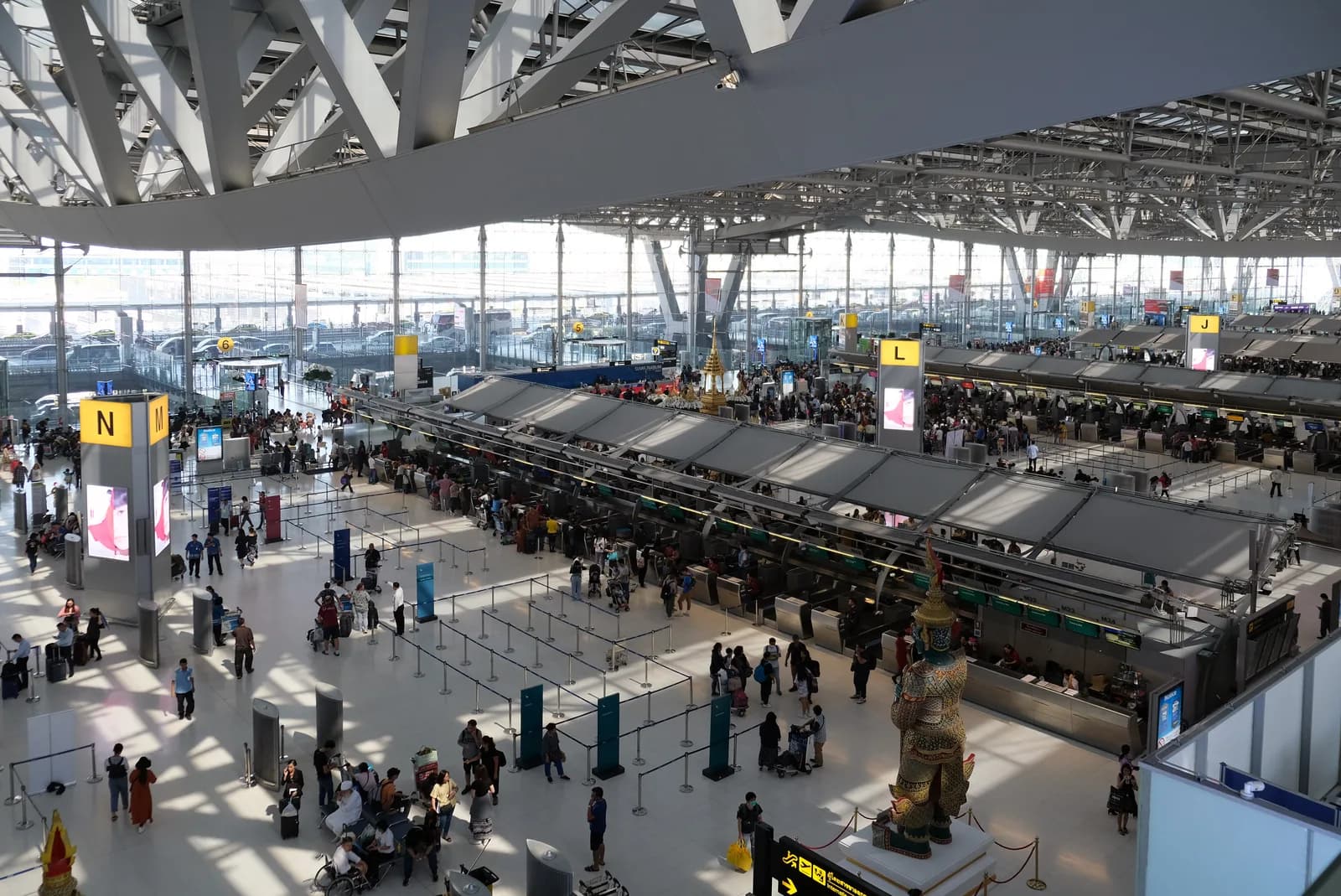
Image: Suvarnabhumi Airport international check-in area, Bangkok. Photo by Kallerna, Wikimedia Commons, CC BY-SA 4.0.
Editorial note: Foreigner's Thailand is an independent guide, not an airline, airport or government agency. Security rules can change at short notice. Always confirm the latest requirements with your airline, the departure airport and CAAT before you travel, and for any immigration questions confirm with Thai Immigration or your embassy.