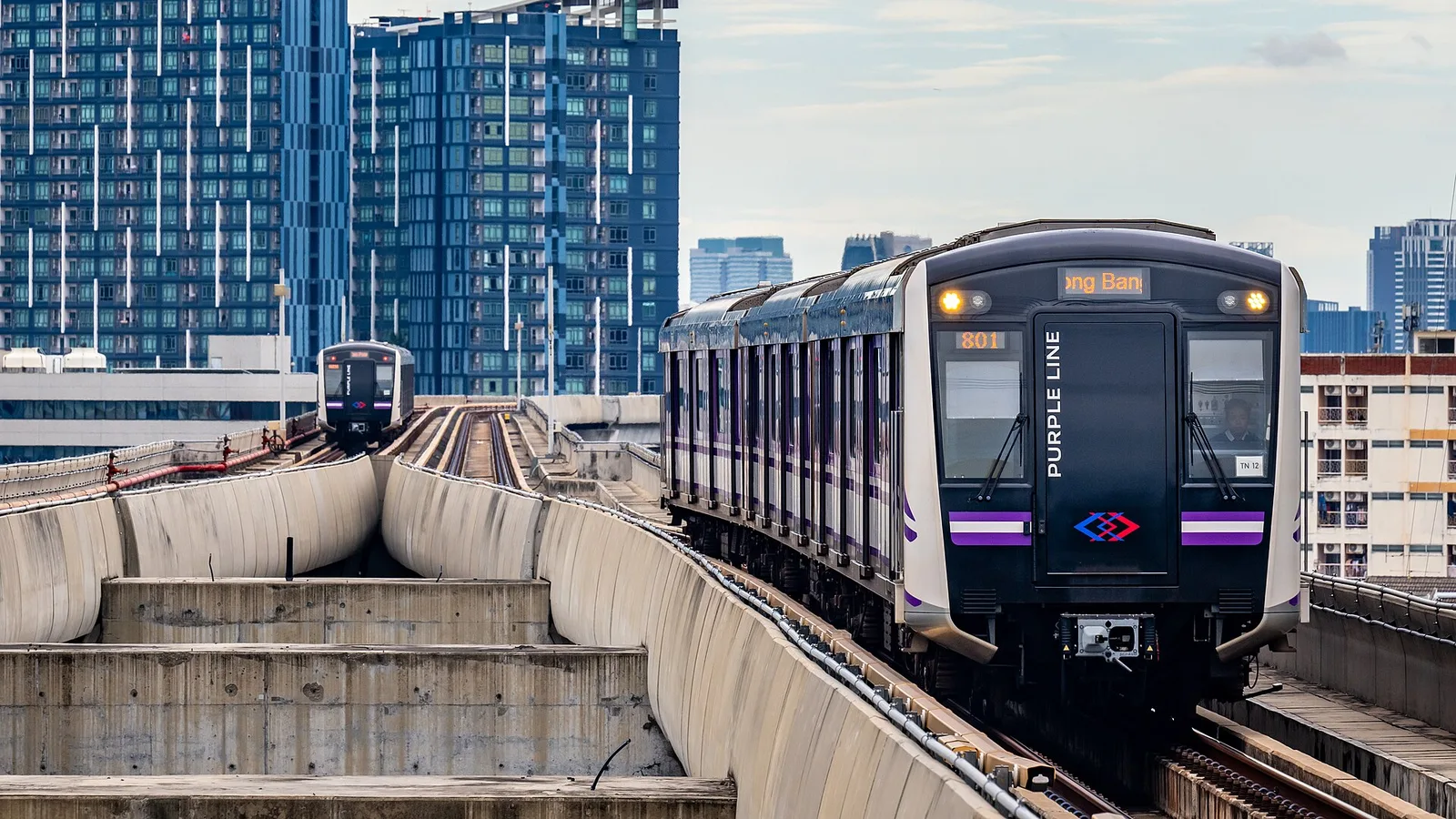
Bangkok's rail network is getting a single fare ceiling in 2027: no more than 45 baht for a journey, however many lines you change between. The catch for expats and visitors is that the scheme, approved by the Cabinet on 3 November 2026, is designed for Thai nationals only. Here is what was decided, how the refund system will work, what foreigners will actually pay, and the one cheap-fare deal that is open to everyone for now.
Reviewed 5 November 2026. Checked against the Royal Thai Government's Cabinet release of 3 November, the Mass Rapid Transit Authority of Thailand (MRTA) daily-fare page, and reporting by the Bangkok Post and The Nation.
At a glance
- What: a joint fare across Bangkok's urban rail network with an entry charge of no more than 17 baht and a maximum of 45 baht per journey, with no second entry fee when you transfer between lines.
- When: 1 January to 31 December 2027, as a one-year measure.
- Where: all lines in Bangkok and the surrounding area, in the wording of the government release and The Nation.
- Who: Thai nationals only, according to the Bangkok Post's report of the Cabinet decision and the Deputy Transport Minister's briefing of 21 October.
- How: you pay the normal fare at the gate with a registered contactless (EMV) Visa or Mastercard; anything above the cap is refunded to your Paotang app account, planned within three days.
- Budget: about 5.807 billion baht, of which 5.785 billion is fare compensation and 22 million covers the cost of the refund transfers.
- For foreigners: expect to keep paying each operator's normal fare in 2027.
What the Cabinet approved on 3 November
The Cabinet, meeting in Udon Thani, approved a Transport Ministry proposal called the joint-fare measure to reduce the cost of living. According to the government's release, the entry charge stays at the existing contract level of no more than 17 baht, the highest fare for a single journey will be 45 baht, and passengers changing between lines will not be charged a fresh entry fee each time. Today, a trip that combines, for example, the BTS and the MRT means paying two separate fares, which is why long cross-city journeys can cost well over 45 baht.
The Cabinet also noted the estimated cost of 5,807 million baht for 2027. The Office of Transport and Traffic Policy and Planning will request the money from the central budget reserve and pay subsidies based on actual use. The Department of Rail Transport, the MRTA, the State Railway of Thailand, the Bangkok Metropolitan Administration and Krungthai Bank were told to speed up preparations. After six months, the MRTA and the BMA must report ridership and revenue figures so the government can negotiate revenue sharing with the private operators.
Why foreigners are not included
The government release itself does not spell out eligibility, but the scheme has been described as Thai-only from the start. On 21 October, Deputy Transport Minister Siripong Angkasakulkiat said only Thai nationals would qualify, and the Bangkok Post's report of the 3 November decision says the new fares are "for Thai commuters only". Registration runs through Paotang, the government's app operated with Krungthai Bank. Check the registration terms when they are published to see which identity documents Paotang will accept.
Nothing published so far suggests that holders of permanent residence, a pink ID card for non-Thais, a work permit or a long-term visa will qualify. If that changes when the registration rules are released, we will update this guide.
How the refund system will work for Thai passengers
- Register in the Paotang app and link a contactless EMV Visa or Mastercard debit or credit card.
- Tap that card at the gates as usual and pay the operator's normal fare.
- If the total for the journey is above 45 baht, the difference is refunded to the Paotang account, planned within three days (a "T+3" arrangement).
The Rabbit card used on the BTS is not supported at first, because Krungthai Bank said its transaction records do not yet meet the required data standard. The ministry has said it plans to add five or six EMV card readers at each BTS Green Line station. Children aged 7 to 15 with a Mangmoom card are expected to be linked to a parent's or guardian's Paotang account.
What this means if you are an expat
- Your fares do not change. Plan your 2027 transport budget on today's fares, not on 45 baht.
- Your Thai family may benefit. A Thai spouse, partner or child can register and use the cap, which can make a real difference for families commuting across the city.
- Do not share cards or accounts. The refund goes to the registered Thai account holder's Paotang wallet. Using someone else's registered card for your own trips is not what the scheme allows.
- Carry a contactless card anyway. Most MRT, SRT Red Line and Airport Rail Link gates now take contactless bank cards, which saves queuing for tokens. Check with your bank about foreign transaction fees if your card was issued abroad. The BTS still relies mainly on the Rabbit card.
The cheap deal foreigners can use: 40 baht a day on the Purple and Red Lines
Since 1 December 2025 the MRTA and the SRT have run a daily fare cap on the MRT Purple Line and the SRT Red Lines. According to the MRTA, general passengers pay no more than 40 baht a day for unlimited rides on either line or both, provided they tap in with the same contactless Visa, Mastercard or UnionPay card. The MRTA page sets no nationality condition. If your actual fares that day add up to less than 40 baht, you pay the lower amount.
This cap is scheduled to end on 30 November 2026. The Transport Ministry has proposed extending it to 31 December 2027, but as of 5 November we have not seen a Cabinet approval. If you commute on the Purple or Red Lines, for example from Nonthaburi or towards Don Mueang, check the MRTA or SRT Electrified Train announcements before December.
Checklist
- Budget for normal fares on BTS, MRT and the Airport Rail Link in 2027.
- Keep a contactless Visa or Mastercard for MRT, Red Line and Airport Rail Link gates; keep a Rabbit card for the BTS.
- If you have a Thai spouse or children, help them register in Paotang once registration opens.
- Use the 40-baht daily cap on the Purple and Red Lines while it lasts, and check whether it is extended after 30 November.
- If you are just arriving and plan to use rail from Suvarnabhumi or Don Mueang, arranging a Thailand eSIM before landing makes it easier to check routes and fares as soon as you clear the airport.
Sources
- Royal Thai Government, 3 November 2026: Cabinet approves joint rail fare measure (in Thai) — https://www.thaigov.go.th/th/news/170840
- Bangkok Post, 3 November 2026: Cabinet approves B45 cap on Bangkok train fares — https://www.bangkokpost.com/thailand/general/3347916/cabinet-approves-b45-cap-on-bangkok-train-fares
- The Nation, 3 November 2026: Thai Cabinet approves THB17-45 rail fare scheme for Greater Bangkok — https://www.nationthailand.com/news/general/40073059
- The Nation, 21 October 2026: Ministry to request Cabinet approval for 2027 rail fares of 17–45 baht — https://www.nationthailand.com/news/policy/40072577
- MRTA: Daily fare policy for MRT Purple Line and SRT Red Line passengers — https://www.mrta.co.th/en/welfare/2708
- Bangkok Post, 25 October 2026: B40/day fare on Red, Purple lines likely to be extended — https://www.bangkokpost.com/thailand/general/3343279/b40day-fare-on-red-purple-lines-likely-to-be-extended
Image: "Bangkok MRT Purple Line J-TREC, Wong Sawang (20240629)" by Takeshi Aida, via Wikimedia Commons, licensed CC BY-SA 2.0 (https://creativecommons.org/licenses/by-sa/2.0), cropped.
This article is for general information only. Fare rules can change before launch, so check official announcements from the Transport Ministry, MRTA, SRT or BTS. For questions about your visa or residence status, confirm with Thai Immigration or your embassy.