Thai Airways (THAI) has confirmed that booking data for about 60,529 passenger records was accessed without authorisation through Amadeus, the company that runs its reservation and passenger service systems. Bangkok Airways has said it was affected by the same incident, and Thailand's aviation regulator, the Civil Aviation Authority of Thailand (CAAT), says these are the only two of the country's seven main airlines that use the affected Amadeus services. No credit card data was involved, flights are operating normally, and affected passengers are to be contacted individually. The bigger risk for most travellers now is not the leak itself but the scam calls, emails and messages that tend to follow a breach like this.
Reviewed 12 November 2026. Checked against Thai Airways' notice of 9 November 2026, Bangkok Airways' announcement, and CAAT's statement as reported on 11 November 2026, with Thai and English-language press used for context.
At a glance
- Who: Thai Airways and Bangkok Airways passengers whose bookings were held in Amadeus systems. CAAT says no other major Thai airline uses the affected services.
- When: unauthorised access to booking data stored between 10 August 2023 and 23 September 2026.
- How many: about 60,529 THAI passenger records. Bangkok Airways has not published a number.
- What: for most records, name, booking reference (PNR), travel date, routing and cabin class. For about 376 THAI records, possibly also email, phone number, passport number, nationality, frequent flyer number, flight, ticket and seat numbers.
- What was not affected: credit card data, according to THAI. Bangkok Airways says there is no evidence that financial data was accessed.
- Next step: THAI says affected passengers will be notified individually once the details have been verified.
What Thai Airways has said
In a notice dated 9 November 2026, THAI said it had been informed by Amadeus IT Group of a security incident involving unauthorised access to booking data stored in Amadeus systems between 10 August 2023 and 23 September 2026. Based on the investigation so far, about 60,529 passenger records may have been accessed.
For those records, the data involved passenger names, the booking reference (PNR), travel date, flight routing and cabin class. A much smaller group, about 376 records, may additionally have included email address, telephone number, passport number, nationality, frequent flyer number, flight number, ticket number, seat number and other related details.
THAI says credit card information was not affected and that, as of the date of its notice, it had not found that the data had been disclosed. Amadeus has told the airline that the login credentials used in the unauthorised access have been revoked, affected passwords reset, and monitoring and detection measures put in place. THAI says its own systems and operations were not affected, that it has informed the relevant authorities, and that it is still analysing the information Amadeus provided.
Bangkok Airways and the regulator
Bangkok Airways has confirmed that it was also affected by the unauthorised access to Amadeus but has not said how many passengers were involved. It says the situation has been brought under control, that it is working closely with Amadeus on the investigation, and that there is no evidence that financial information was accessed. It asks passengers to be careful with unexpected contacts or messages, particularly any request for personal or financial information, and to contact the airline directly if in doubt.
CAAT checked the seven main Thai airlines and found that only Thai Airways and Bangkok Airways use the affected Amadeus reservation services. According to the regulator, there is no evidence so far that passenger data has been used unlawfully, and the incident has not affected flight safety or airline operations. CAAT says it will keep monitoring the airlines' personal data protection and cybersecurity measures.
Part of a wider Amadeus incident
The incident is not limited to Thailand. Amadeus provides passenger systems to many airlines around the world, and several Asian carriers, including Japan Airlines, Cathay Pacific, Malaysia Airlines, Singapore Airlines, Korean Air, Asiana Airlines and Finnair, have been reported as affected. If you have flown with more than one of these airlines since August 2023, you may receive more than one notice.
Why the leak matters even without card details
Names, booking references, routes and travel dates are exactly what a scammer needs to sound convincing. A caller who knows your PNR and your Bangkok–Phuket flight date can easily pose as the airline and ask you to "confirm" a passport number, pay a "rebooking fee" or click a link to claim a refund. Passport numbers and phone numbers, where exposed, make such approaches more believable still.
So the practical advice is the same that airlines give after any breach: treat any unexpected contact about your booking with suspicion, even if the details are correct.
What to do now
- Wait for an official notice, but don't rely on email alone. THAI says it will contact affected passengers individually. If you receive a message, do not use links or phone numbers in it. Open the airline's official website or app yourself, or call the number listed there.
- Never give card details, OTPs or passwords to someone who contacts you about a booking. Airlines do not need your one-time password to process a refund.
- Check your booking in the airline's official app or website using your booking reference, and look for changes you did not make.
- Change your frequent flyer password if you have a THAI or Bangkok Airways frequent flyer account, and do not reuse it elsewhere. Check your miles balance for unexpected activity.
- Watch your bank and card statements. Card data was not involved, but scammers may still try to trick you into making a payment.
- Be extra careful with messages in Thai and English that mention refunds, compensation, flight changes or "data breach claims".
- Keep your passport safe and watch for misuse. If you believe your passport number has been used fraudulently, contact your embassy for advice.
If you live in Thailand
If a scammer does trick you into transferring money, act fast. Thailand's Anti Online Scam Operation Center (AOC), run by the Ministry of Digital Economy and Society with the police, the Bank of Thailand and other agencies, takes reports only through hotline 1441, where you can ask for the receiving account to be suspended. Before calling, have your full name and ID number, your bank account details, the date and time of the transfer and the scammer's account number ready. You will receive a police case ID by SMS and must then meet the investigator at a police station within 7 days. Note that the AOC says it does not contact people through social media, so anyone claiming to be "AOC" on LINE or Facebook is not genuine. Keep screenshots of all suspicious messages.
Checklist
- Flown THAI or Bangkok Airways since August 2023? Watch for an official notice.
- Do not click links or call numbers in unexpected messages; go to the airline's official site or app yourself.
- Never share OTPs, passwords or card details over the phone or chat.
- Change your frequent flyer password and check your account.
- Check bank statements and report any fraud to your bank at once.
- If you lose money to a scam in Thailand, call the AOC on 1441 straight away.
Sources
- Thai Airways, 9 November 2026, "Amadeus Reports Unauthorized Access to THAI Passenger Data": https://www.thaiairways.com/en-th/content/news-and-announcements/amadeus-reports-unauthorized-access-to-thai-passenger-data/
- Bangkok Airways, announcement on the information security incident involving Amadeus: https://www.bangkokair.com/announcement/view/information-security-incident-involving-amadeus
- Daily News, 11 November 2026, CAAT's review of seven Thai airlines (in Thai): https://www.dailynews.co.th/news/6350639/
- Bangkok Post, 10 November 2026, "THAI passenger data compromised in Amadeus security breach": https://www.bangkokpost.com/thailand/general/3352180/60000-thai-bookings-compromised-in-amadeus-breach
- The Thaiger, 12 November 2026, "CAAT says only 2 from 7 main Thai airlines affected by data breach": https://thethaiger.com/news/world/aviation/thai-airways-and-bangkok-airways-affected-by-data-leak
- Ministry of Digital Economy and Society, Anti Online Scam Operation Center (AOC 1441): https://mdes.go.th/mission/detail/9122-Anti-Online-Scam-Operation-Center
- Tech Wire Asia, 11 November 2026, the wider Amadeus incident across Asian airlines: https://techwireasia.com/2026/11/thai-airways-data-breach-amadeus/
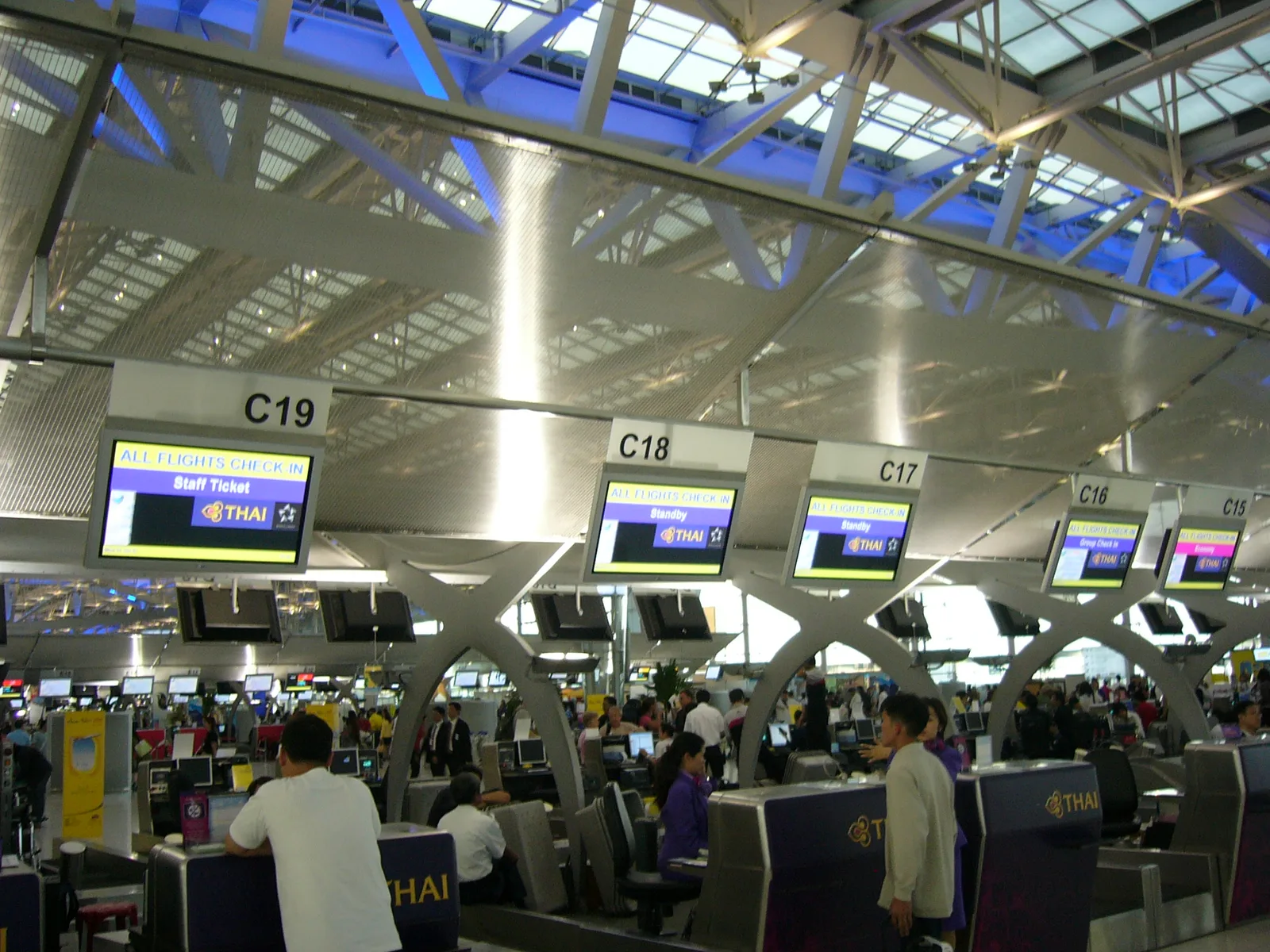
Image: "VTBS-Thai Airways Check-in counters" by User:Mattes, via Wikimedia Commons, released into the public domain.
This article is general travel information, not legal or security advice, and the investigation is ongoing. Follow official notices from Thai Airways, Bangkok Airways and CAAT. For questions about your passport or your stay in Thailand, confirm with Thai Immigration or your embassy.